

I was having a chat with a friend of mine at some point about the going rates for a Freelance Level Designer in the industry.
I have done some charity work for a while so my experience with getting paid for my code is… limited. This bugged me a bit trying to figure out the right price. The problem is, a flat rate for a level is not easy to discern. It’s not as easy as going to a grocery store and picking a 2D side-scrolling shooter level. Level design takes planning, money, research, money, resource allocation, money, testing, and money.

I decided to check what the going rates for Freelance Developers were and it’s definitely a wacky untamed market.
Every potential worker has a price, the issue is figuring out if they are worth the price, if said price is competitive and if the price is fair to them.
Looking at Fiverr (inaccurate as a statistical sample, I admit) there is a massive distribution of starting rates for developers. This can be due to location, skill level, qualification, time constraint, living condition and experience.
I started to think to myself: What is the best way to determine the right rate to pay for, not just a developer, for any aid in Game Development? Be it a Concept Artist, Level Designer, Game Engineer, Composer, Background and Sprite Artist or any other job role in Game Development, there should be a simple system for determining the base rate for employing someone.
I have two ideas so far:
Irrespective of Qualifications and Experience.
This method of deciding a base rate is done assuming two criteria.
Firstly, the potential employee’s skill level or experience is an unknown variable that can be determined in a trial phase.
Secondly, the living situation of the employee (the location, living expenses and struggles) are similar to the potential employer.
Basically, you will have to go by an hourly rate totalling the entire time spent completing the project. A good visualisation for this would be:
Living Wage per hour × Number of Hours worked per week
× Number of Weeks of expected work
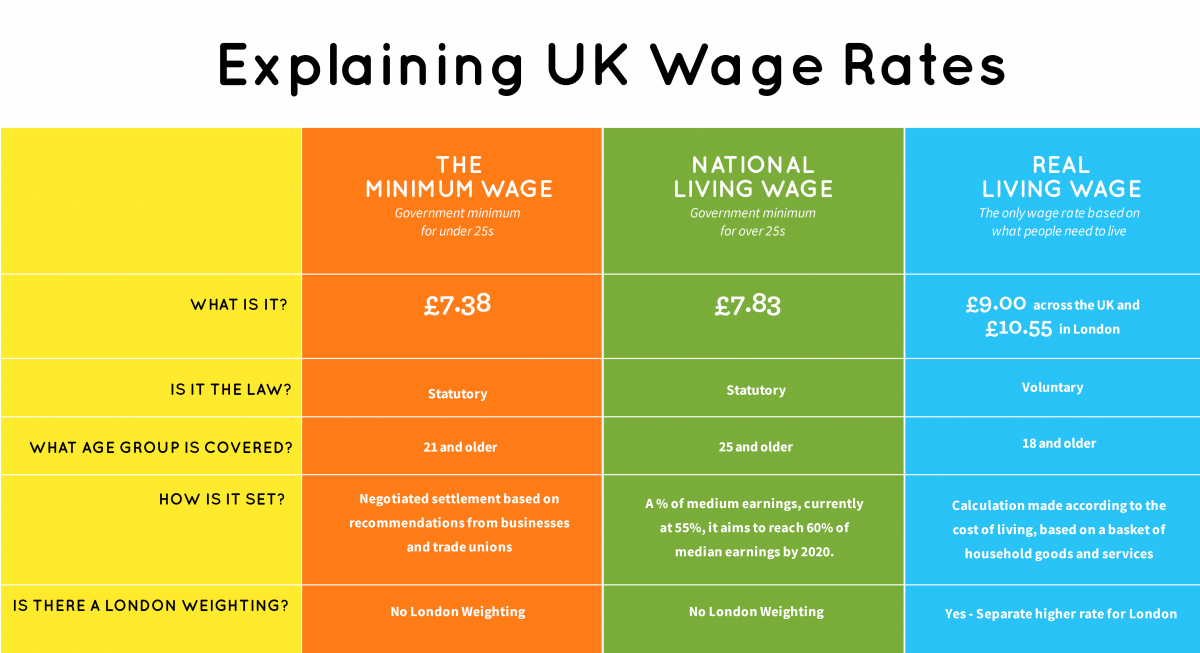
As opposed to the minimum wage, a living wage is the expected wage someone would have to be paid to live comfortably in their current location.
(image source: https://www.livingwage.org.uk/what-real-living-wage)
For someone living in Glasgow, where I reside, the living wage is £9 /hr. This meaning for a 40 hour week, an employee would be paid £360 /week , £1440 /month or £17,280 /annum. This is negotiable depending on the skill of the worker.

The upside to this approach is ensuring your employee gets a fair living wage they can have for comfortable living experience while under your employ. This also prevents problems such as gender, racial, disability and sexual orientation based discrimination because everyone gets a fair wage.
The problem I see here is that, just because it’s equal for all, doesn’t make it fair for all. Minor differences in rent, home utility bills, taxation and skill level mean that the pay may not feel fair between staff.
Taking Skill, Experience and Qualification into Account…
The inverse of the previous idea is to have the employees paid based on their known skill level. This can be done by looking at the industry standard as well as agreeing to a rate based on known pay scales for the job role.

You have to take into account the industry standard for competitive rates, fairness across employees and taking time to verify the skills of your potential employees.
Going with this route almost guarantees your staff (provided they are skilled to match the pay) aren’t snapped up by more resourceful companies or individuals. This assumes you can afford to pay them at the industry standard rates as well.
All this assumes you can afford to pay for any help whatsoever. Frankly, a lot of us who want to start making games are sitting in our bedrooms singing an alternate version of ‘Wouldn’t It be Nice’ by The Beach Boys. One thing I kept thinking of when I was deciding whether I needed help was, ‘would it be cheaper if I learned to do this stuff myself?’ In my case, I had to look at whether information was more affordable than help. Time is money, therefore, can I weigh the time I’m going to spend and money I’m going to save against hiring someone to get the work done quicker, at a harsher cost?
To be honest, All I’m doing is procrastinating while I get my GDD finished, I have no answers right now.
 HomeKick Games